
Shilajit has gone from a traditional ingredient to one of the most talked-about names in the supplement aisle. SupplySide Supplement Journal reported that shilajit appeared in several new formulations at Natural Products Expo West 2026. NutraIngredients also listed it among the emerging actives alongside established favourites like collagen.
Whether it's worth trying depends on what the evidence shows and on how good the product is. Here's a straightforward guide.
What is shilajit?
Shilajit is a dark, sticky substance found in mountain regions such as the Himalayas and the Altai range. Its origin isn't fully settled. SupplySide notes that some believe it forms from decayed plant material, while others think it is a mineral secreted gradually from rock. It has a long history of traditional use, and today it is sold as a resin or in capsules.
What does the research say?
The research is still early. The same SupplySide report says there are only a handful of clinical trials, and that the ingredient needs more investigation and a standardised chemical composition.
- A 2026 pilot study. A 28-day open-label pilot study gave healthy, moderately active adults 500 mg of shilajit resin a day. It reported improvements in strength, endurance and fatigue measures, with no serious adverse events. Open-label pilots have no placebo group, so they point to areas for further research rather than proving an effect.
- A larger trial is under review. A randomised, double-blind, placebo-controlled trial of shilajit resin has been posted as a preprint. Preprints haven't completed peer review, so it's worth waiting for the final published version.
- A cautious view from safety bodies. Operation Supplement Safety says research using up to 500 mg of shilajit extract suggests short-term use may be safe. It also says there is little reliable evidence for claims about energy, stamina or mental performance, and that some studies were funded by supplement companies.
In Great Britain, shilajit has no authorised health claims, so we can't tell you it will boost energy, performance or anything else. We can tell you what the research looks like and how to shop sensibly.
The safety question every buyer should ask
The biggest concern with shilajit is quality, and it's the one a good brand should be happy to discuss.
Because shilajit forms in rock, raw material can carry heavy metals such as lead, arsenic and mercury. A review in Phytotherapy Research by Sidney Stohs concluded that processed, purified shilajit is safe for human consumption, while raw, unprocessed material can exceed acceptable limits. OPSS also points out that without laboratory testing, you can't know what is in a product or whether it is free of heavy metals.
When you're comparing products, look for:
- Purification: purified resin rather than raw material.
- Third-party testing: ideally a certificate of analysis covering heavy metals.
- A clear ingredients list: no unnecessary fillers or binders.
- A clear dose: a stated amount per serving and sensible directions.
As with any supplement, speak to your GP or pharmacist before starting if you are pregnant, breastfeeding, taking medication or managing a health condition.
Our pick: The Good Guru Pearl Shilajit Resin 20g
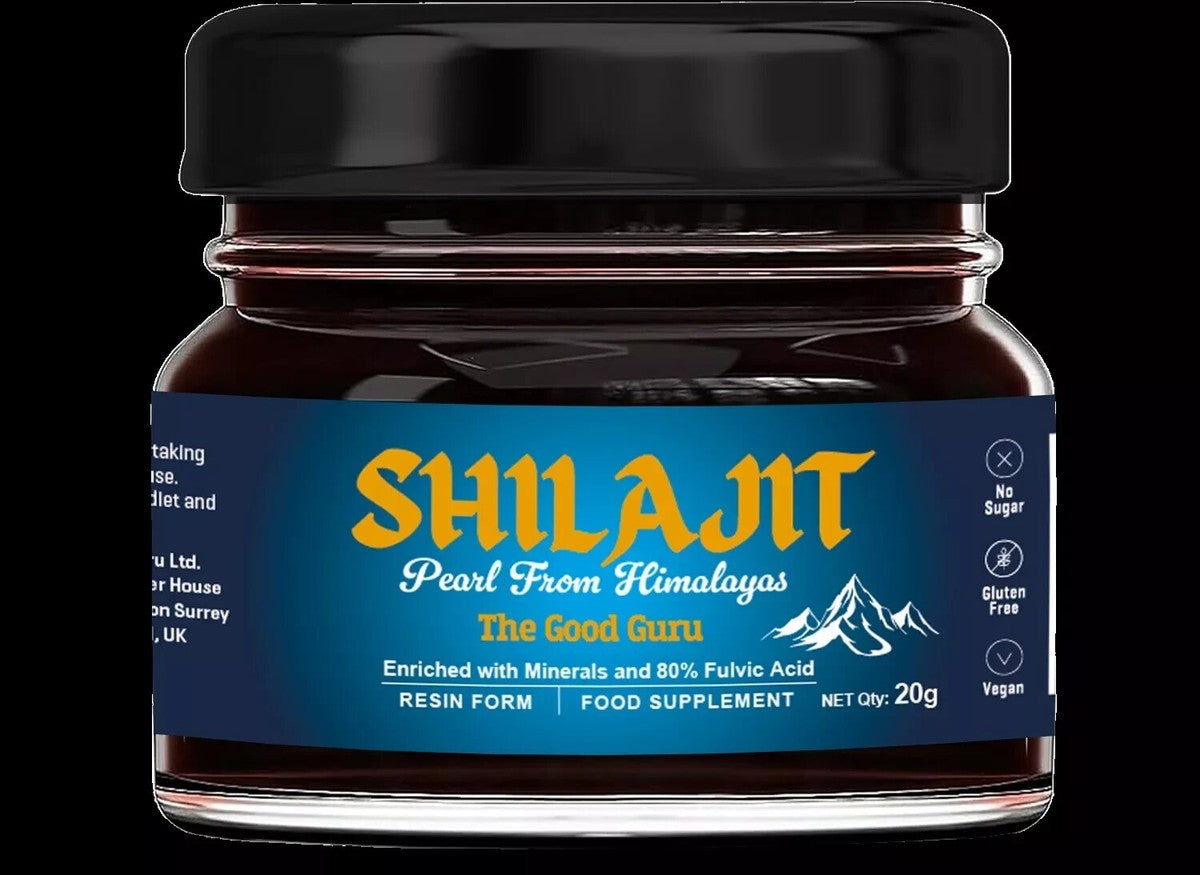
If you'd like to try shilajit in its traditional resin form, The Good Guru Pearl Shilajit Resin (20g) is a straightforward option at £19.95. Each serving provides 500 mg of purified shilajit resin from the Himalayas. It contains no fillers or binders, is non-GMO and is suitable for vegetarians and vegans.
The directions are simple: take one spoonful daily with food, and don't exceed the recommended daily intake.
Prefer a bigger tub or a different origin? Browse our full shilajit resin and tablets collection, including The Good Guru Gold Shilajit Resin (30g) and Altai Shilajit Resin (50g).
Frequently asked questions
Is shilajit safe to take daily?
Purified shilajit appears to be well tolerated in short-term studies at around 500 mg a day, but long-term safety data is limited. Quality varies between products, so choose a purified resin and check the dose.
How do I take shilajit resin?
Follow the directions on your product. For The Good Guru Pearl Shilajit Resin, that's one spoonful daily with food.
How is shilajit different from ashwagandha?
They are different ingredients. Shilajit is a mineral-rich resin, while ashwagandha is a root extract. Some products combine the two, such as our Good Guru Gold Shilajit + Ashwagandha KSM66.
Can shilajit replace a healthy lifestyle?
No. Sleep, a balanced diet and regular movement matter far more than any supplement.
The bottom line
Shilajit is intriguing, but the evidence is still developing and quality matters a great deal. Choose a purified product, check the dose, and treat it as a small part of a healthy routine. Questions? Get in touch or browse more guides on the One Life blog.